
AI
RAG vs Fine-Tuning vs Long Context: Which Should You Use?
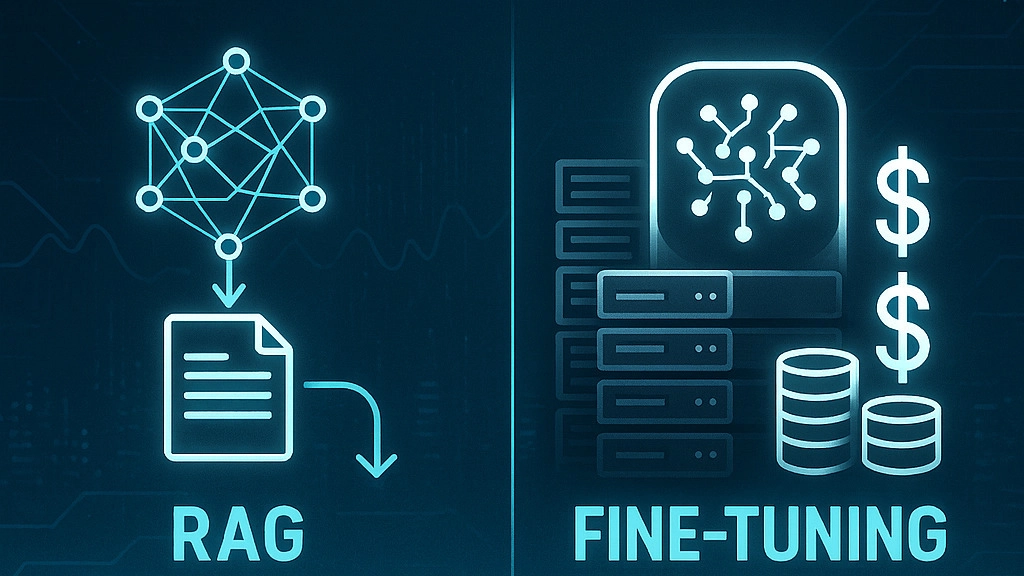
A team builds an internal assistant over a weekend. It answers HR questions beautifully in the demo. Then someone updates the leave policy, and the assistant keeps quoting the old one for weeks. Sound familiar? This is the moment most teams start asking the question behind RAG vs fine-tuning: how should we actually give a language model our company's knowledge?
There are now three realistic answers: retrieval-augmented generation (RAG), fine-tuning, and simply pasting everything into a long context window. Each solves a different problem, and picking the wrong one is an expensive way to learn that.
The Three Approaches in Plain Language
RAG: look it up first
With RAG, your documents are split into chunks and indexed, usually as embeddings in a vector database. When a user asks something, the system retrieves the most relevant chunks and hands them to the model along with the question. The model answers from that material.
Fine-tuning: change the model's habits
Fine-tuning continues training a model on your own examples. It is good at teaching tone, output format, domain vocabulary, and consistent behaviour. It is a poor way to store facts that change, because updating knowledge means another training run.
Long context: just include everything
Modern models accept very large prompts, so for a small, stable set of documents you can often include all of it directly. No index, no pipeline. The catch is cost and latency on every request, and the fact that models can still miss details buried in the middle of a huge prompt.
How to Choose: A Practical Decision Guide
- Knowledge changes often, or must be cited? Start with RAG. You update a document, re-index it, and the answer changes. You can also show users the source.
- Need a consistent style, format, or classification behaviour? Consider fine-tuning, after you have tried better prompts and examples.
- Small, static corpus and a prototype to build this week? Long context is the fastest route to something working.
- Large or growing corpus? Stuffing it all into a prompt gets slow and costly, so retrieval wins.
Many production systems combine them: retrieval for facts, a lightly tuned model for voice and structure. Common advice across practitioner write-ups is to try prompting first, add RAG for knowledge, and tune only when you can point to a behaviour problem that remains.
Where Each Approach Goes Wrong
RAG fails at retrieval, not generation
When a RAG answer is wrong, the model is usually not the culprit. The wrong chunk was retrieved, or the right fact was split across two chunks. Chunk size, metadata filters, hybrid search (keyword plus semantic), and reranking often matter more than which model you choose.
Fine-tuning goes stale
A tuned model reflects the data it saw. Teams that fine-tune on a product catalogue discover the catalogue changes monthly. You also need clean, representative training examples, and building those is real work.
Long context hides its costs
Sending a huge prompt on every question multiplies your token bill and slows responses. Reported cost comparisons vary widely between sources, so measure with your own traffic instead of trusting a headline multiplier.
Real-World Examples
- Customer support bot: RAG over help articles, so answers stay current and link to the source.
- Contract summariser with a fixed template: fine-tuning or strong prompting for the format, retrieval for clause lookup.
- One-off analysis of a single long report: long context, no infrastructure needed.
- Healthcare or finance assistants: RAG with access controls, because you need to know which document produced which answer.
Actionable Takeaways
For developers
- Build a small evaluation set of 30 to 50 real questions with known answers before choosing anything.
- Try prompting and long context first as your baseline.
- Add RAG when the corpus grows or freshness matters, and log what gets retrieved so you can debug it.
- Fine-tune only to fix a measured behaviour gap.
For business leaders
- Ask which data changes, and how often. That answer drives the architecture.
- Insist on source citations for anything customer-facing or regulated.
- Budget for ongoing data quality work. It outlasts the model choice.
Conclusion
The question is not which technique wins. It is which problem you are solving: missing knowledge, wrong behaviour, or a small amount of text that fits in a prompt. Match the tool to the problem, measure it, and keep the design simple until the evidence says otherwise.
Planning an AI assistant over your own data and not sure where to start? The team at Annz Tech would be glad to talk it through with you.
Retrieval teaches your model what to know; fine-tuning teaches it how to behave.